By Ryan T.July 31, 2013
Several years ago I reviewed David Sehat?s then-new book, The Myth of American Religious Freedom. Published in 2011, the book was intended as a corrective to what Sehat characterized as the conventional idea that Americans celebrate an unbroken and unblemished tradition of religious liberty. Demonstrating that America?s record of toleration and freedom isn?t flawless, Sehat chronicled many episodes of religious discrimination during the nineteenth century Although, as many revisionist texts do, Sehat?s book may have overcorrected, he introduced an important new awareness of the historical reality of not only religious persecution, but subtler forms of establishment coercion that existed in the land of the free during the nineteenth century. Mormons were, quite naturally, a constituency of Sehat?s work, though most of his focus was elsewhere. I expressed in that post my opinion that Mormonism presents a natural point of entry for the study of religious freedom in America. Because of their controversial practice of polygamy and their broad assumption of political autonomy, Mormons were at the center of much national debate over the boundaries of religious freedom in the latter half of the nineteenth century, and this something that scholars like Kathleen Flake, Sarah Barringer Gordon, and now Leigh Eric Schmidt have worked on in various ways. [1] Relatively less has been said, though, about how early Mormons themselves conceived and understood religious liberty. How did this eminently democratic idea, resting on a premise of ideological pluralism, square with Mormon political theology?
Continue Reading
By Jordan W.July 30, 2013
Though one can trace a correspondence between Mormon scriptural and legal hermeneutics back to Joseph Smith, that indirect correlation has evolved in relation to ecclesiastical schisms and shifts and broader social and political developments. Despite recent criticisms, the equation between Mormonism and constitutional conservatism that developed in the wake of the Cold War era and that found embodiment in the person of Ezra Taft Benson remains a truism for some Latter-day Saints, many of whom embrace a scriptural literalism. A number of Saints uphold the Constitution as “A Heavenly Banner,” to be placed alongside the LDS canon. Indeed, mistrust of executive, legislative, and judicial interpreters leads some to insist on originalist interpretations (which, of course, are still interpretations) of the Constitution, while evidencing an openness to non-originalist interpretations of scripture, or at least to the readings of their leaders, which might be understood as literal.[1] While one can formulate defensible arguments that scriptural literalism and conservative constitutionalism are fruits of Mormonism, I want to suggest that the seeds of quite different approaches to sacred scriptural and legal texts can be found in the rich soil of early Mormon thought. Within the Mormon framework, accepting a text as sacred does not necessarily demand strict or literalist readings and may even call for alternative approaches. Before tracing out these potentialities in a subsequent post, here I aim to suggest that they may relate to broader intellectual trends and developments in antebellum biblical and constitutional interpretation.[2]
Though not the only force directing constitutional thought in the antebellum period, the South’s peculiar institution uniquely forced many Americans to reconsider the Constitution’s place in the present. Since the 1830s, a number of radical abolitionists concluded that the nation’s preeminent legal document had worn out its welcome and joined William Lloyd Garrison in dismissing it as a “covenant with death” and “an agreement with Hell.”[3] Such figures accepted the proslavery interpretation of their opponents as historically accurate and then condemned the Constitution as an outdated and immoral creed. They proved willing to throw out the Bible as well.[4] Other abolitionists, including Gerrit Smith and Frederick Douglass, advanced antislavery readings of the Constitution. Like Garrison, they appealed to the Declaration of Independence, but they read Madison’s text in light of Jefferson’s.[5] Static proslavery and antislavery readings dominated antebellum constitutional interpretation, leading to pro- and anti-constitutional readings, but some interpreters began to propose readings that valued the Constitution as an adaptable document “suited to time,” a kind of “raft, which should bend and yield, take the very shape of the waves, let the water in and out freely through its seams and junctures, and by its loose couplings and elastic movement divide and dissipate the force of any sudden shock.”[6]
The emerging view of the Constitution as malleable corresponded to a view of the Bible as a moldable book, a discussion that arose in relation to historical examinations of the biblical text. This relationship can be seen in Unitarian-turned-Transcendentalist Theodore Parker’s writings. His deep engagement with biblical criticism led him to distinguish between transient and permanent biblical truths and nourished his belief in divine communication.[7] Parker believed in the Bible’s usefulness as the historical expression of true religion, but the truth he privileged most rested in a Christ that aimed to foster future Christs. Indeed, Parker echoed Emerson in suggesting that by making Christ “the Son of God in a peculiar and exclusive sense–much of the significance of his character is gone.”[8] His religion was not restricted to a place, a past, a book, or a man, but “the inward Christ, which alone abideth forever, has much to say which the Bible never told,” or, as he added in a later edition, “much which the historical Jesus never knew.”[9] Parker’s abstract and minimalist beliefs freed him from allegiance to literalist and static meanings and allowed him to posit the Bible’s malleability. When biblical scholars used historical reasoning to interpret Paul’s decision to send a slave back to his owner and to then assert a clear correspondence between that decision and the Fugitive Slave Act, it was Parker’s engagement with biblical criticism and his deep-seated belief in an innate religious guide and the progress of religion that led him to accept that interpretation as historically accurate and to then dismiss it as historically dated. In the early 1840s, he lamented that “men justify slavery out of the New Testament, because Paul had not his eye open to the evil, but sent back a fugitive. It is dangerous,” he warned, “to rely on a troubled fountain for the water of life.”[10]
Parker’s approach to the Bible informed his interpretation of the Constitution. In response to Moses Stuart’s proslavery Conscience and the Constitution (1850), he suggested that “there is a “short and easy method” with Professor Stuart, and all other men who defend slavery out of the Bible. If the Bible defends slavery, it is not so much better for slavery, but so much the worse for the Bible.”[11] Parker was no respecter of founding documents. He asserted that “if the Constitution of the United States will not allow [the nation to end slavery], there is another Constitution that will.”[12] In referencing a higher law, Parker made it clear that he preferred “conscience to cotton,” the Bible, and the Constitution.[13] In his view, historical research evidenced that these texts contained outdated moral and legal teachings, but rather than joining Garrison in jettisoning them, he ultimately maintained that these founding texts also conveyed transcendent religious and legal truths. While dismissing strict literalist readings, Parker claimed the spirit of these sacred religious and legal texts, which allowed him posit their inherent capacity to adapt to historical change and modern circumstances.
Much separates Theodore Parker’s hermeneutics from Joseph Smith’s, and the relationship between scriptural and constitutional exegesis is much clearer in the Transcendentalist’s thought than in the Mormon Prophet’s. While holding in mind important distinctions and differences between early Mormon thought and broader developments in biblical and constitutional interpretation, we might consider whether Smith’s unique critique of the Bible and his emphatic assertion of new revelation might allow for and even demand a reading of sacred texts, both religious and legal, in light of historical change and development. In other words, does early Mormon thought call for a reading of the Constitution through the lens of continuing revelation? And, if so, what does that look like? I leave you to consider these questions, and hope to address them in part, at least, in a subsequent post.
[1] As Stanley Fish explains, the gesture to “disavow interpretation in favor of simply presenting the text” is actually a gesture in which one set of interpretive principles is replaced by another that happens to claim for itself the virtue of not being an interpretation at all.” In this article, Fish famously concluded that “interpretation is the only game in town.” Stanley Fish, “What Makes Interpretation Acceptable,” in Is There a Text in This Class? The Authority of Interpretive Communities (Cambridge, MA: Harvard University Press, 1980), 353, 355.
[2] On the relationship between biblical and constitutional hermeneutics, see Jaroslav Pelikan, Interpreting the Bible and the Constitution (New Haven: Yale University Press, 2004).
[3] William Lloyd Garrison to Rev. Samuel J. May, July 17, 1845, in Walter M. Merrill, ed. The Letters of William Lloyd Garrison (Cambridge, Mass.: Harvard University Press, 1973): 3:303.
[4] See, for example, William E. Cain, ed., William Lloyd Garrison and the Fight against Slavery: Selections from the Liberator (Boston: St. Martin’s Press, 1995), 29-36.
[5] For an outline of these positions and a discussion of Douglass’s slow and studied adoption of Smith’s position, see David W. Blight, Frederick Douglass’ Civil War: Keeping Faith in Jubilee (Baton Rouge: Louisiana State University Press, 1989), 26-35.
[6] “A Chapter on Slavery,” The North American Review 92 (April 1861): 492-93, quotes on 493.
[7] See Parker, “A Discourse of the Transient and Permanent in Christianity,” in The Critical and Miscellaneous Writings of Theodore Parker, Minister of the Second Church in Roxbury (Boston: James Munroe and Company, 1843). On Parker’s prolonged engagement with biblical criticism, including the writings of figures such as De Wette and Strauss, see Dean Grodzins, American Heretic: Theodore Parker and Transcendentalism (Chapel Hill: University of North Carolina Press, 2002).
[8] Parker, “A Discourse of the Transient and Permanent in Christianity,” 158.
[9] Parker, A Discourse of Matters Pertaining to Religion, 376. See Parker, A Discourse of Matters Pertaining to Religion, 4th ed. (Boston: Little, Brown and Company, 1856), 354.
[10] Parker, A Discourse of Matters Pertaining to Religion (Boston: Charles C. Little and James Brown 1842), 375. Others, including William Ellery Channing, contended that Paul, in fact, advanced antislavery sentiment, but slavery “had so penetrated society” in New Testament times that Paul “satisfied himself with spreading principles which, however slowly, could not but work its destruction.” Channing, Slavery (Boston: James Munroe and Company, 1835), 111. On the New Testament debate over slavery, see Albert J. Harrill, “The Use of the New Testament in the American Slave Controversy: A Case History in the Hermeneutical Tension between Biblical Criticism and Christian Moral Debate,” Religion and American Culture: A Journal of Interpretation 10, no. 2 (Summer 2000): 149-186. Channing’s interpretation was a kind of originalist argument based on the New Testament authors’ original expectations of change. A similar kind of argument emerged in relation to the Constitution. This originalist expectation of change found expression, for example, in the dissenting opinions of the Dred Scott decision (1857). John McLean wrote that “our independence was a great epoch in the history of freedom, and while I admit the Government was not made especially for the colored race, yet many of them were citizens of the New England States, and exercised, the rights of suffrage when the Constitution was adopted, and it was not doubted by any intelligent person that its tendencies would greatly ameliorate their condition.” Similarly, in reference to the founders, Benjamin Robbins Curtis contended that “that a calm comparison of these assertions of universal abstract truths and of their own individual opinions and acts would not leave these men under any reproach of inconsistency; that the great truths they asserted on that solemn occasion, they were ready and anxious to make effectual, wherever a necessary regard to circumstances, which no statesman can disregard without producing more evil than good, would allow; and that it would not be just to them nor true in itself to allege that they intended to say that the Creator of all men had endowed the white race, exclusively, with the great natural rights which the Declaration of Independence asserts.” Dred Scott v. John F A. Sandford, 60 US (19 Howard) 393, 537, 574-75 (1857).
[11] Parker, “The Slave Power,” in The Works of Theodore Parker, Centennial Edition, 15 vols. (Boston: American Unitarian Association, 1907-1913), 11:272.
[12] Parker, “The Slave Power,” 11:285.
[13] Parker, “The Slave Power,” 286.
By Edje JeterJuly 28, 2013
As the examples in the first post showed, a Hydra could represent an individual (Joseph Smith), an institution (the Church), or a concept. The concept-as-Hydra was probably most common, implicating ideas like violence or fraud, usually with some specific incident(s) under discussion as an individual head (or heads) of the larger monster (for non-Mormon-related examples, see images below). [1]

Continue Reading
By Ben PJuly 25, 2013
[Today’s contribution to this month’s Mormonism & Politics series comes from Brittany Chapman, who basically runs the Church History Library nowadays.]
?Stronger than my political convictions,? wrote suffragist Ruth May Fox, ?was my belief in the political rights of women.?[1]
 I?ve been thinking lately about how women view themselves, and the seeming monumental change in that perception since the nineteenth century. Often when we speak of women in politics during that time period, we instantly mark ?suffrage? as one of woman?s greatest achievements. Our nineteenth-century heroines are those who touted women?s advancement in the public sphere?education, employment, and, most heralded, the vote. Rightly so. Now four or even five generations removed from that innovation, the value of universal suffrage is obvious and marginalizing woman?s voice at the ballot box is unthinkable. It is easy to assume the value of the vote was always obvious and that every woman always wanted it. But alas, such was not the case for hundreds of thousands of women. So, who were the women who did not want the vote, and why? What were they saying? And, at the root of it all, how did they view themselves?
There is a fascinating piece by Susan Fenimore Cooper (the daughter of novelist James Fenimore Cooper) entitled ?Female Suffrage: a Letter to the Christian Women of America.? Cooper, well-read and well-bred, represented a preponderance of women when she argued that they should not have the right to vote. In the same breath, she advocated women receiving higher education, equal pay for equal work, and other basic equalities. How did these seemingly inconsistent ideas of equality co-exist?
Continue Reading
By Natalie RJuly 24, 2013
 The deceased Lenore Romney, the mother of 2008 and 2012 presidential candidate Mitt Romney and the wife of republican governor of Michigan from 1963 to 1969 George Romney, came into the spotlight in 2012 when both Time Magazine and the Washington Post featured stories that covered her effect on her son?s political career. Both stories featured her failed run for a senate seat in Michigan in 1970. Compared to the contemporary images of Ann Romney as a housewife, what was most striking about these stories was not that Lenore Romney did not win the election for the U.S. senate seat but that she had run for office at all. It is necessary to note that Ann Romney also did actually run for and win a public office position in the 1970s. She was elected as the town meeting representative in Belmont, Massachusetts in 1977.[1] However, probably because she has not pursued her own political career, the story has fallen mostly by the side after her husband stepped into political spotlight.
Continue Reading
By Ben PJuly 22, 2013
Editors:
Jared Hickman, The Johns Hopkins University
Elizabeth Fenton, The University of Vermont
 Over twenty years ago, Nathan Hatch highlighted a gap in the study of American religion, noting that, ?for all the attention given to the study of Mormonism, surprisingly little has been devoted to The Book of Mormon itself.? Though scholars of US religion and culture have produced a wide range of work on Mormonism, its history, and its peoples in the past two decades, Hatch?s assertion remains largely true. In the field of US literary studies particularly, The Book of Mormon stands as a telling absence, perhaps because questions about what it is and where it came from have overshadowed discussions of how it works and what it does. This essay collection begins with the premise that, whatever else it may be, The Book of Mormon is a significant, world-altering literary text that should be studied as such.
Continue Reading
By Edje JeterJuly 21, 2013
The Hydra, or more specifically, the Lernaean Hydra, was a poly-cephalic reptilian killed by Heracles/Hercules in Greek mythology. It had, depending on the source, nine or fifty heads; if one were cut off, two grew to replace it; its breath and blood were poisonous. [1] Both pro- and anti-Mormon writers and orators used Hydra rhetoric in their contests.
The hydra was a common polemic image applied to various groups and ideas on both sides of the Atlantic from at least the 1700s on. [2] A particularly prominent instance in the US arose in connection with the 1830s ?Bank War? in which President Andrew Jackson railed against the (Second) Bank of the United States as a ?hydra of corruption? (see images below). [3]

Continue Reading
By Ben PJuly 18, 2013
 This week, the summer 2013 issue of Journal of Mormon History was uploaded to the journal’s USU website. I’m pleased to say that it is a very solid issue with several provocative articles from up-and-coming scholars. You can see the full table of contents at the site, and everything is worth reading, but allow me to highlight four articles I particularly enjoyed (which also happen to be the first four in the issue):
1. Lee Wiles, “Monogamy Underground: The Burial of Mormon Plural Marriage in the Graves of Joseph and Emma Smith.” This fun, important, and smart articles examines the narratives Mormons told of their founding prophet’s marriages, and offers yet another sophisticated take on the changing perceptions within LDS memory. Along with Steve Taysom’s article along the same lines, we can easily see this dynamic tradition of interpreting the past in a way that embodies the present.
2. Christine Elyse Blythe, “William Smith’s Patriarchal Blessings and Contested Authority in the Post-Martyrdom Church.” I’m biased, since I research both the succession as well as patriarchal blessings, but this fills an important niche within both fields. Christine uses the robust body of patriarchal blessings given by William Smith during a short period of 1845 in order to examine the mercurial figure’s relationship to and position within a church in transition.
Continue Reading
By AmandaJuly 17, 2013
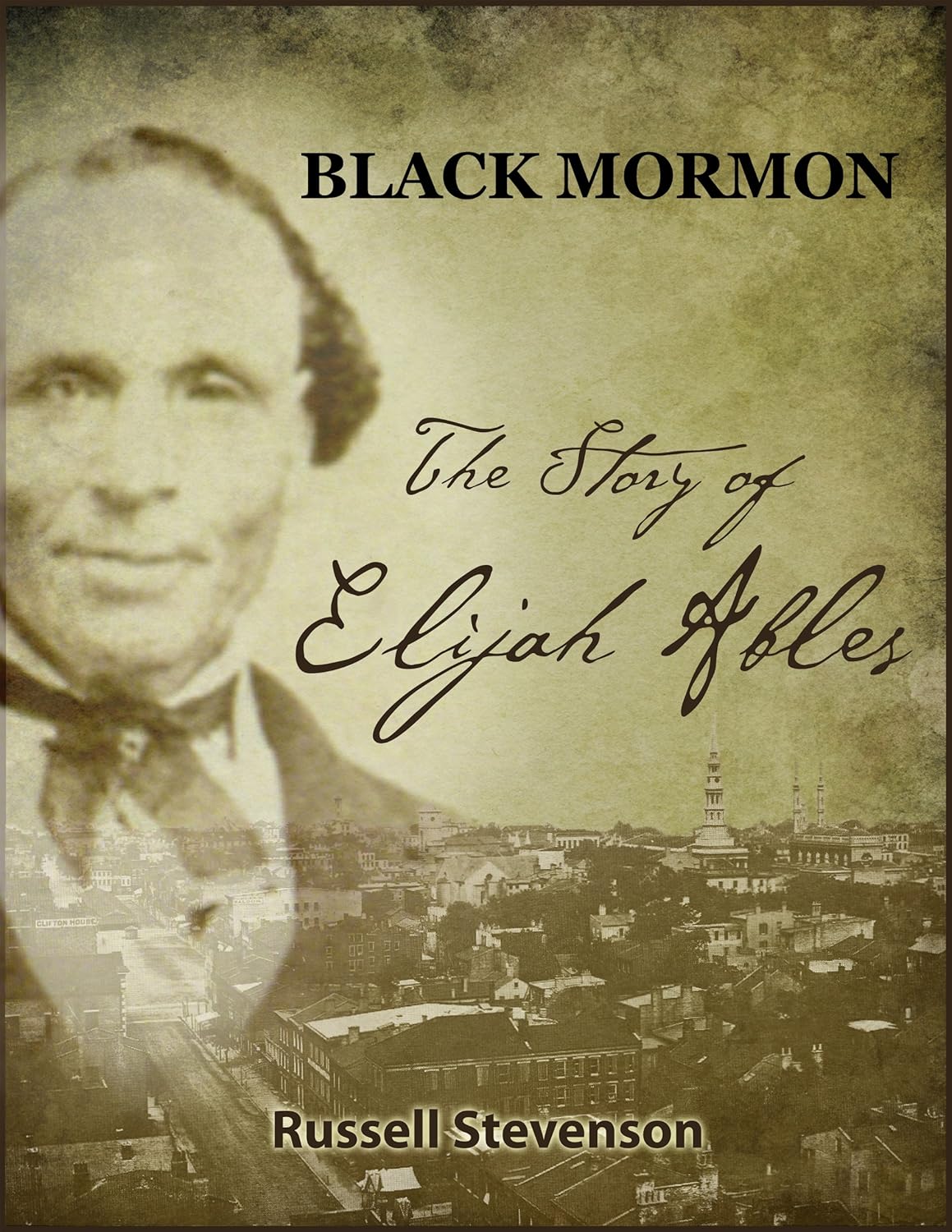 Recently, two biographies were published on Elijah Abel/Ables, a black Mormon man who held the priesthood in the nineteenth century with the blessing of Joseph Smith and many of his contemporaries. Rather than attempt a traditional review, I decided to write a conversations post with Russell Stevenson, the author of one of the two biographies. Stevenson is an independent scholar with a master?s degree in history from the University of Kentucky. He recently self-published Black Mormon: The Story of Elijah Ables.
In order to make the post easier to read, I have arranged the questions I asked and Stevenson?s responses into categories.
General Questions
The Spelling of Abel?s Name
Amanda: In your book, you use a spelling of Elijah Abel’s name that many readers will be unfamiliar with. Where does it come from? Why did you decide to go with that spelling?
Continue Reading


Recent Comments
Glen Larson on CFP: Book of Mormon: “Please add me to your mailing list. Thanks”
Mark Staker on Legacies in Mormon Studies: “Jenny was always generous in sharing her knowledge. She was not only an exceptional educator (who also taught her colleagues along the way), but she…”
Gary Bergera on Legacies in Mormon Studies: “Jenny's great. Thanks for posting this.”
Kathy Cardon on Legacies in Mormon Studies: “I worked in the Church's Historical department when Jenny was in the Museum. I always enjoyed our interactions. Reading this article has been a real…”
Don Tate on Legacies in Mormon Studies: “Very well done and richly deserved! I am most proud of Jenny and how far she has come with her life, her scholarship, and her…”
Ben P on Legacies in Mormon Studies: “My favorite former boss and respected current historian!”