Display of Book of Mormon Original Manuscript – 1:30 pm Panel presentation: “Complexities of Conservation, Imaging, and Piecing together the Fragments of the Original Manuscript of the BoM for the Joseph Smith Papers,” by Emiline Twitchell, Tyler Thorsted, and Robin Jensen Church History Library, Salt Lake City
Please find a flyer attached to this post if you’re able to share it with others!
Join the Church History Department of The Church of Jesus Christ of Latter-day Saints for a virtual career day event and explore exciting career opportunities with the Church History Department.
Do you have a passion for Church history? Are you a history student who wants to work in your field? Join us for a virtual career day info session, interact with current employees from the Church History Department, and learn about potential career paths and upcoming internships.
The Faith and Knowledge Conference was established in 2007 to bring together Mormon graduate students (a member of any Restoration church) in religious studies and related disciplines in order to explore the interactions between religious faith and scholarship. During the past seven conferences, students have shared their experiences in the church and the academy and the new ideas that have emerged as a result. These papers and conversations provided thought-provoking historical, exegetical, and theoretical insights and compelling models of how to reconcile one’s discipleship with scholarly discipline.
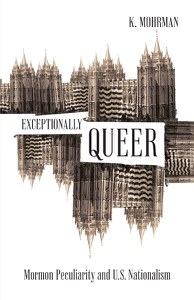
I haven’t read a book as historiographically disruptive to Mormon Studies as K. Mohrman’s Exceptionally Queer: Mormon Peculiarity and U.S. Nationalism. Covering 1830 to the present, it covers a much longer period than most monographs on Mormonism. In addition to a longer framing, Mohrman employs queer feminist theory, queer of color critique, critical ethnic studies, and other methodological tools to reveal what Mormonism’s “peculiarity” (or lack thereof) tells about what it means to be American. The book’s rich examination of Mormonism’s place in the United States and also for what Mormonism’s being defined as “peculiar” reveals about the biopolitics of American exceptionalism. In short, Mohrman argues that Mormonism is not exceptional, and in fact, shows what it means to be American across time in U.S. history.
This review comes from Makoto Hunter, a graduate student in history at the University of California–Santa Barbara studying American religious life at the intersection of race, gender, sexuality, and public memory. A former research and editorial assistant for the Intermountain Histories digital history project, she has authored two online public history series, titled “Mapping the Polygamy Underground” and “Confederate Markers in the Intermountain West.”
Reading Caroline Kline’s Mormon Women at the Crossroads: Global Narratives and the Power of Connectedness, published this year by the University of Illinois Press, has been an exercise of discovery, delight, and richly provoking insights. Based primarily on 98 anonymized oral history life interviews conducted with Latter-day Saint women of color (archived at the Claremont Colleges Library), Kline’s interdisciplinary work is part ethnography, part lived religion, and part theology. The book documents the lives of Latter-day Saint women of color, examines their experiences with and perspectives on intersections of religion, gender, race, and class, and argues for understanding their agentive lives through the lens of a shared moral orientation which Kline calls non-oppressive connectedness. Attentive to interviewees’ expressed priorities and values, Kline both shares their stories in their irreducible complexity and highlights key throughlines and contextually specific nuances in what ultimately synthesizes into a lay theology expressed from the margins of the tradition. As such, in addition to gathering personal, textured accounts of what it is like to live as a woman of color in Mormonism, Crossroads also expresses a Mormonism that is interpreted, adapted, and authored by women of color. This book is an indispensable companion for any study of contemporary Mormonism, particularly as expressed in The Church of Jesus Christ of Latter-day Saints (Crossroads’ denominational focus).
The Church Historian’s Press invites you to attend the 2022 Joseph Smith Papers Conference, which will be held at the Conference Center of The Church of Jesus Christ of Latter-day Saints in Salt Lake City, Utah, on September 9, 2022.
The conference theme is “Text and Context in Nauvoo.” The event will commemorate the publication of volumes 12, 13, and 14 of the Documents series, which feature Joseph Smith documents produced between March 1, 1843, and May 15, 1844. Presentations will explore themes such as politics, theology, religious practice, gender, race, law, and finance in Nauvoo.
This event is free to attend, but space is limited. The conference program and registration are available on the Joseph Smith Papers website.
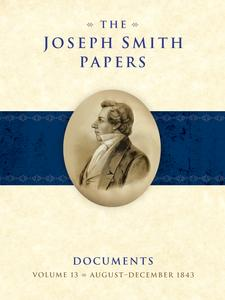
Documents, Volume 13 was edited by Christian K. Heimburger, Jeffrey D. Mahas, Brent M. Rogers, J. Chase Kirkham, Matthew S. McBride, and Mason K. Allred. Visit josephsmithpapers.org for more information.
The Joseph Smith Papers Project recently released the thirteenth volume of their Documents series, which covers the relatively short period of August-December 1843. It comprises ninety-eight documents, transcriptions, contextualization, and footnoting that “chronicle a busy, often tumultuous period of [Joseph Smith’s] life” (xix). Helpfully, they show a religious leader, politician, businessman, and family man managing many concerns while acting primarily in his prophetic ministry. As with other volumes, D13 shows the workings of a man who saw no distance between the sacred and the profane. This collapsing of boundaries was evident, too, in his personal life. Even as he escaped the Missouri courts, he could not escape difficulties in home life or pressure in his religious ministry.
Book reviews are their own genre. They are not like anything else that you’ll write as a scholar. This is true for several reasons, which I’ll outline, but certainly because they are doing a particular kind of work in their analysis. Articles and books are generally self-explanatory for what they do as pieces of academic writing—book reviews’ values are not as easily grasped at first blanche.
In this post, I hope to share a few pointers for how to write a helpful book review. I use “helpful” and not “good” purposefully. Book reviews are utilitarian and meant to be engaged and digested by more people than will read the book. Know the genre and recognize its value.
Please enjoy the following presentations. One is by Rick Turley, entitled “The Rise and Fall of Mark Hoffman” and was delivered at Utah State University:
The second is by Emily Utt, on time capsules in Latter-day Saint buildings, entitled “Wine, Wheat, and Whatnots: The Material Culture of Cornerstones,” delivered at a presentation for the Utah State Historic Preservation Office:
Mark Staker on Legacies in Mormon Studies: “Jenny was always generous in sharing her knowledge. She was not only an exceptional educator (who also taught her colleagues along the way), but she…”
Kathy Cardon on Legacies in Mormon Studies: “I worked in the Church's Historical department when Jenny was in the Museum. I always enjoyed our interactions. Reading this article has been a real…”
Don Tate on Legacies in Mormon Studies: “Very well done and richly deserved! I am most proud of Jenny and how far she has come with her life, her scholarship, and her…”
Recent Comments
Mark Staker on Legacies in Mormon Studies: “Jenny was always generous in sharing her knowledge. She was not only an exceptional educator (who also taught her colleagues along the way), but she…”
Gary Bergera on Legacies in Mormon Studies: “Jenny's great. Thanks for posting this.”
Kathy Cardon on Legacies in Mormon Studies: “I worked in the Church's Historical department when Jenny was in the Museum. I always enjoyed our interactions. Reading this article has been a real…”
Don Tate on Legacies in Mormon Studies: “Very well done and richly deserved! I am most proud of Jenny and how far she has come with her life, her scholarship, and her…”
Ben P on Legacies in Mormon Studies: “My favorite former boss and respected current historian!”
Hannah J on Legacies in Mormon Studies: “I really enjoyed this! Going to be thinking about playing the long game for a while. Thanks Amy and Jenny.”