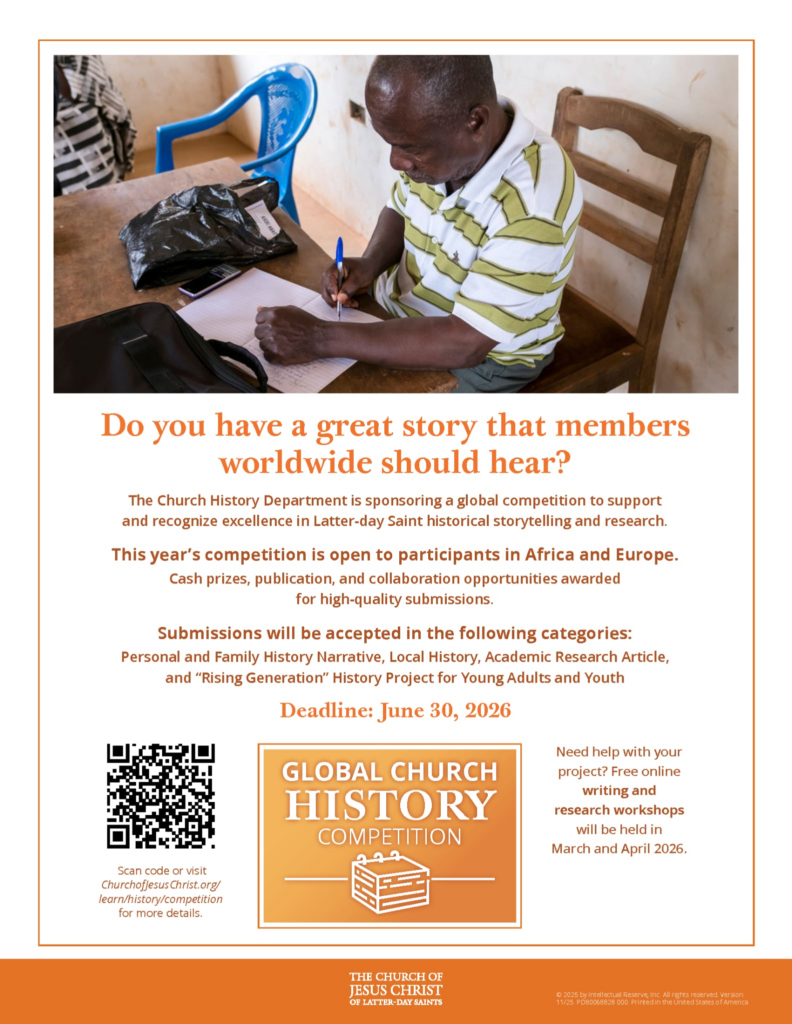
The Church History Department of The Church of Jesus Christ of Latter-day Saints invites applications for grants to conduct research in its archival, art, and artifact collections in Salt Lake City, Utah. These grants are intended to offset travel and expenses for performing research at the Church History Library and/or Museum in Salt Lake City, Utah. We hope the grants will stimulate the examination of underrepresented groups and topics in Latter-day Saint history, such as women, youth, children, individuals outside the United States, immigrant groups, the globalization of the Church, and twentieth and twenty-first century history. We encourage all scholars who are interested in Latter-day Saint history, Latter-day Saint art history, or Latter-day Saint studies to apply, regardless of their affiliation with the Church or previous experience in researching Latter-day Saint history. Preference will be given to individuals who have not received a previous research grant from the department. Current employees of the Church History Department are not eligible for grants.
The department intends to award five types of grants in 2026:
The Journal of the Mormon Social Science Association (JMSSA) is accepting submissions for a special issue exploring the intersection of Mormon traditions and digital platforms. Papers accepted for the special issue will receive an honorarium of up to USD 1,000. We welcome interdisciplinary perspectives that explore how the technological, architectural, and political structures of digital platforms are not only governing how Mormonism is perceived, represented, and encountered by the broader public but also mediating and reshaping belief, practice, and community across various Mormon traditions. We welcome both scholarly/empirical studies and shorter reflective submissions.
Special Editors
Spencer Greenhalgh (School of Information Science; University of Kentucky) Spencer Stewart (School of Information Studies & Department of History; Purdue University) Rosemary Avance (School of Media & Strategic Communications; Oklahoma State University)
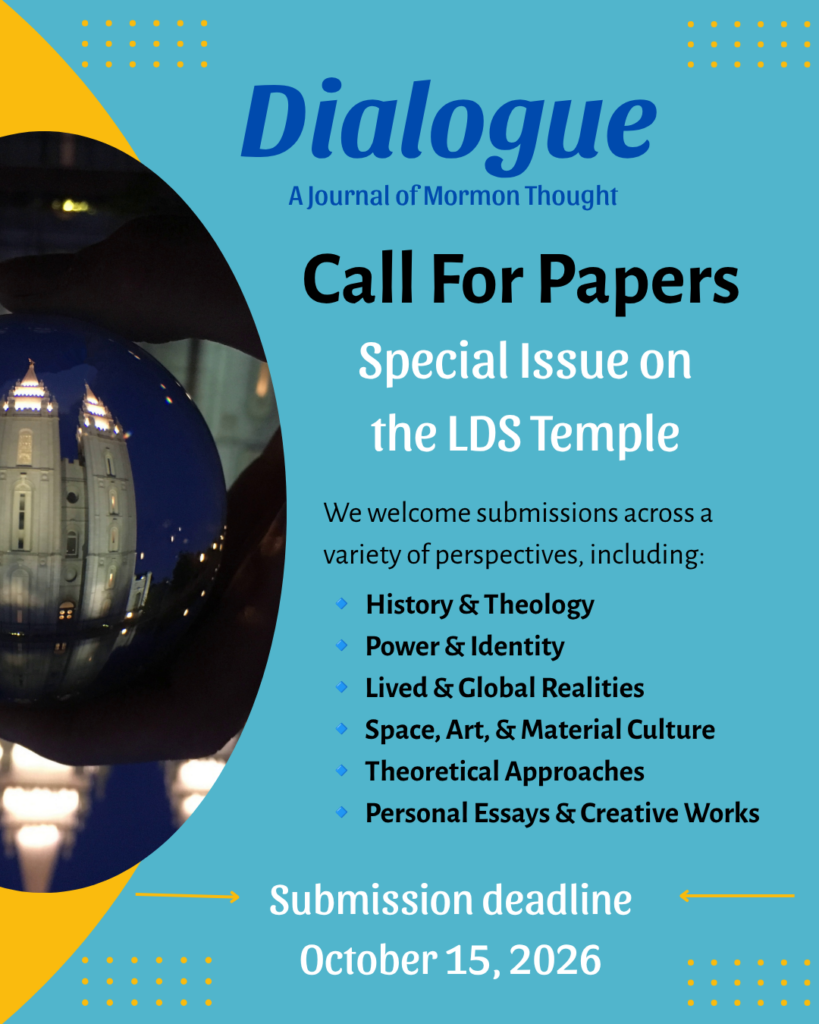
The temple stands at the center of Latter-day Saint theology, ritual life, and community identity. As a sacred space of covenant-making, cosmological instruction, and familial sealing, the temple shapes how members understand their earthly purpose and eternal destiny. At the same time, the temple has been a dynamic site of change, reflection, and negotiation—marked by evolving rituals, architectural developments, and shifting internal discourses surrounding authority, inclusion, and sacred space.
Dialogue invites submissions for a special issue dedicated to exploring the temple from a wide range of disciplinary and experiential lenses. We particularly welcome submissions that engage with gender dynamics, institutional power structures, material realities, and the lived experiences of a global Latter-day Saints.
Submissions may address, but are not limited to, the following topics:
Seeking participants from outside the Latter Day Saint tradition to be in an academic study about their experiences at Joseph Smith Jr. era historic sites (since 2021) operated by the LDS Church. It seeks to fill a gap where there is little collected about multi-faith experiences at early Mormon sites. It is anonymous, and someone can either do an interview or type their answers. This study has been IRB approved by Missouri State University (Springfield, Missouri).
Consortium of Historians of Idaho and its Periphery (CHIP) Inaugural Conference
Dear Friends and Colleagues,
We are excited to announce the formation of CHIP, the Consortium of Historians of Idaho and its Periphery. This new organization is dedicated to the history of Idaho and its connections to the broader Intermountain West region. CHIP’s founders seek to create a dedicated space to explore the complex historical dynamics of the Gem State, while serving to foster community among the many far-flung professionals whose work connects to Idaho history.
Our inaugural meeting will take place at Idaho State University in Pocatello, ID, on Saturday, September 19, 2026. We invite proposals for presentations on research related to the history of Idaho and the region, broadly construed. The conference is open to interested faculty, graduate students, library and archival professionals, and public historians.
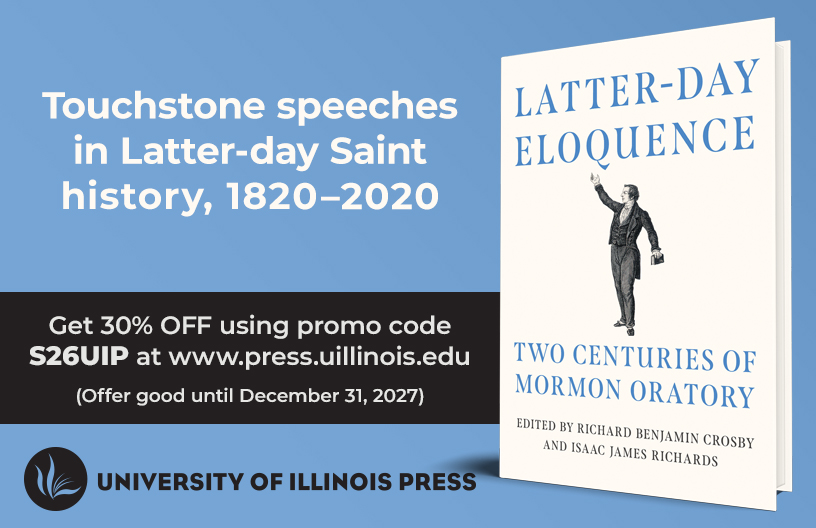
From friends of the blog Ben Crosby and Isaac Richards:
We are pleased to announce that Latter-day Eloquence: Two Centuries of Mormon Oratoryis now available for pre-order through the University of Illinois Press website. Use the code S26UIP for 30% off. This landmark anthology collects fifty-five speeches, each of which is introduced and contextualized by a qualified scholar, including several notable experts from Latter-day Saint studies and Mormon history.
“Latter-day Eloquence is spectacularly successful in disclosing the workings of the Latter-day Saint oratorical tradition—a species of the prophetic voice not confined to general conference addresses. Whether you are a student of history, letters, rhetoric, or psychology, or simply a thoughtful layperson wishing to understand this movement’s range and potency, this collection might be one of the few 700-page tomes you want on your shelves. Read from the beginning, it tells a story—but it can as easily be read backwards or selectively.” – Philip L. Barlow, coeditor of The Oxford Handbook of Mormonism
The Tanner Humanities Center at the University of Utah continues to support emerging scholarship in the field of Mormon Studies through its Graduate Research Fellowship in Mormon Studies. The fellowship was the first of its kind in the United States and provides a year of funding for a doctoral student whose research focuses on the history, beliefs, and culture of the Church of Jesus Christ of Latter day Saints or other religious groups that trace their origins to Joseph Smith Jr.
This is a reminder of the upcoming April 6, 2026 deadlines for the Call for Papers, Student Conference Scholarships, and Award Nominations for John Whitmer Historical Association’s 2026 Annual Conference in Council Bluffs, Iowa, on September 24-26, 2026.
Glen Larson on CFP: Book of Mormon: “Please add me to your mailing list. Thanks”
Mark Staker on Legacies in Mormon Studies: “Jenny was always generous in sharing her knowledge. She was not only an exceptional educator (who also taught her colleagues along the way), but she…”
Kathy Cardon on Legacies in Mormon Studies: “I worked in the Church's Historical department when Jenny was in the Museum. I always enjoyed our interactions. Reading this article has been a real…”
Don Tate on Legacies in Mormon Studies: “Very well done and richly deserved! I am most proud of Jenny and how far she has come with her life, her scholarship, and her…”


Recent Comments
Glen Larson on CFP: Book of Mormon: “Please add me to your mailing list. Thanks”
Mark Staker on Legacies in Mormon Studies: “Jenny was always generous in sharing her knowledge. She was not only an exceptional educator (who also taught her colleagues along the way), but she…”
Gary Bergera on Legacies in Mormon Studies: “Jenny's great. Thanks for posting this.”
Kathy Cardon on Legacies in Mormon Studies: “I worked in the Church's Historical department when Jenny was in the Museum. I always enjoyed our interactions. Reading this article has been a real…”
Don Tate on Legacies in Mormon Studies: “Very well done and richly deserved! I am most proud of Jenny and how far she has come with her life, her scholarship, and her…”
Ben P on Legacies in Mormon Studies: “My favorite former boss and respected current historian!”